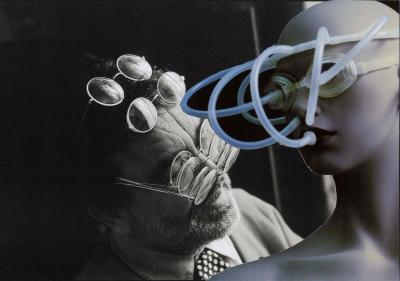
The truth is that I had long I had such a good seeing an interview of my beloved pataphysical Fernando Arrabal, and nothing less than a head to head with South Korea's Yoon Usun, the famous reporter indomitable Wyoming Indian program "The Intermediate." With the excuse that it has rescued the play "The Garden of Earthly Delights" (1967) de Arrabal, threw Yoon Usun ovaries to try to interview one of the greatest exponents of the "impossible", remember that in 1962 he created the Panic Movement, a year after our author met André Breton. Form the group Fernando Arrabal, Roland Topor French (1938) and the Chilean Alejandro Jodorowsky (1930), mixing, among other trends, with elements of surrealism waste Dadaists. Panic theater explained as a ceremony, a ritual to contact a higher reality. Beyond that, he has directed seven feature films. He has published thirteen novels, eight hundred books of poetry, several texts for theater and several trials among them books on chess. His novels have been translated into numerous languages. His Letter to General Franco had published a special impact on the dictator's life. Featured on the death of Franco in the English group of the five most dangerous with Santiago Carrillo, Dolores Ibarruri The Passion, Enrique Lister and Valentín González El Campesino. In this humble blog Arrabal introduced to his work through film "Viva " and today rescued a summary of this work: "The Garden of Earthly Delights"

In 1967 Arrabal wrote the play "The Garden of Earthly Delights" triptych inspired by the famous El Bosco with the same title. Like the work of Arrabal bosquiana can be interpreted as an allegorical tale about the spiritual transformation of the individual with the desire as the driving force. In the first scene we see Lais, and admired a beautiful actress, singing a sad song. He has retired from public life and now lives alone with her nine sheep and a "man-ape", Zeno, who is in love with her. In a telephone interview with fans Lais tells his life. Past and present intertwine in a complicated network of different episodes of his life, sometimes it leads to agonizing memories. Lais spent his childhood in a Catholic asylum for orphans where her only friend was Miharca. Lais Miharca Unlike shows rebellious tendencies and can not accept authoritarian and moralistic rules of asylum which repeatedly have to suffer humiliating punishment for the nuns. Lais only dream of freedom, and one day escapes into the woods where he finds the TELOC magician who invites her to travel back in time through his magic helmet. In one of these trips Lais sees itself as a future actress. The work culminates in the second act with a violent conflict between Lais and Miharca, who has since had a relationship with TELOC. In a state of madness Miharca comes to kill her. Lais is saved at the last moment and kill Miharca with a giant knife. Lais and Zeno the end come together in an egg. She offers her soul is in a jam jar. After eating the contents Zeno becomes humanized as Lais animal features. The scenario is like a maze, that alchemy is a symbol of the painful journey of man towards his own center. The Melancholy of Lais is "raw material", ie the basic substance necessary for the process can start. The I need to find the origin of the disorder and see what's behind it. In Lais manifests itself as a bubble that oscillates between his brain and heart. The bubble is a sign of fleeting Mercury has to be attached to sulfuric burning. The sulfuric and Mercury represent two dialectically related aspects of Stone Philosopher, and correspond to the consciousness and subconscious of the human psyche. Lais frustrations of the problem are based on Jung called "PERSON", ie paper or mask behind which hides the true self of the individual and tends to have its origin in early childhood education. You could say that is a compromise between the self and the norms of society. For example Lais nine sheep symbolize purity and virginity that Lais wants to appear. To release the Psyche of false wrap Lais person has to relive their traumatic childhood at the home.
The three characters that surround it can be seen as personifications of different aspects of the psyche of Lais, as actors in their interior drama. In their different costumes magician, player, judge and executioner TELOC can be interpreted as the figure of animus or seapapel the knife in the work of Arrabal. The knife is a symbol of death here means the end of the process before the resurrection. The tortures suffered by the characters are therefore the purification rituals needed to attain the Philosopher's Stone. The triptych of Bosch is cyclical. The process ends where it began in the left pane to Christ as a symbol of divine union. In alchemy Christ is a frequent symbol of the Philosopher's Stone is a picture of the totality of the human psyche, where all opposites are united, and as such is the ideal supreme spiritual development of mankind. Both Arrabal's work as the El Bosco is a veiled criticism of dogmatic religion that does not evoke the wisdom of the individual but fills him with guilt complexes or shame for being who he is: a being with spiritual qualities and animals. Arrabal wrote "The Garden of Earthly Delights" shortly after leaving prison. I played a month in one of the cells of the Franco for having said minor blasphemy. The Bosco lived in the 15th century. and had to speak with even more caution and perhaps be the reason why his account of the Garden of Earthly Delights is even more enigmatic and symbolic. Such Once that's why I wanted to tell the story of the alchemical wedding simulating respect for the religious faith of his time. Otherwise you might have touched the punishment of the Bonfire of the Inquisition. The artists exhibiting strange truths about the life of the human subconscious has almost always been persecuted by the authorities dare not confront their own inner monsters. The sulfuric and Mercury present two dialectically related to the Philosopher's Stone, and correspond to the conscious and the subconscious of the human psyche.
Lais's frustrations are based on the problem that Jung called "PERSON", ie paper or mask behind which hides the true self of the individual and usually have their origin in early childhood education. You could say that is a compromise between the self and the norms of society. For example Lais nine sheep symbolize purity and virginity that Lais wants to appear. To release the Psyche of false wrap Lais person has to relive their traumatic childhood at the home. The three characters that surround it can be seen as personifications of different aspects of the psyche of Lais, as actors in their interior drama. In their different costumes magician, player, judge and executioner TELOC can be interpreted as the figure of animus or the male element of the sub-consciousness of women and their spiritual guide. As a magician TELOC directs the spiritual transformation of leaving Lais see their artistic abilities as an actress. In its negative form the Animus can also show your cruelty if the complexes are very repressed women. TELOC acts as both judge and executioner to force Lais to relive their experiences erotic and humiliating punishment he suffered in the asylum. As masculine TELOC Lais awakens longing for a man because she only had homosexual experiences with his childhood friend. Miharca appears as a personification of the Shadow of Lais, which according to Jung is the guilt complexes that hinder children's spiritual transformation. The recognition of the Shadow inevitably involves conflict in alchemy appears symbolically allegorical as scenes of fighting with flaming dragons or other monsters. Although extremely difficult and unpleasant Shadow finally manifests as an aid in the development of the individual. Lais Miharca treated with great cruelty to enter into the "Garden of Earthly Delights" and says "I would sacrifice myself for you." Before
ritualized sacrifice is a violent struggle between the two which is represented as a dramatization of the internal struggle between his ego Lais rebel and adapted, from its lust and spirituality. In one scene Lais and Miharca strong as two horses hooked and TELOC acts as the rider tries to address symbolically opposing passions Lais. The giant knife is a symbol phallic in alchemy and the instrument with which I have to remove its impurities. In Lais these impurities are all moral standards of their education that prevent accepting their sexuality. After slaughter Miharca ritualized Animus function as a spiritual guide is fulfilled, and must be divorced from Lais TELOC. The ape-man, Zeno, can be interpreted as the repressed libido Lais who is locked in a cage. As a young man the male element of the sub-consciousness of women and their spiritual guide. As a magician TELOC directs the spiritual transformation of Lais leaving to see their artistic abilities as an actress. In its negative form the Animus can also show your cruelty if the complex women are very suppressed. TELOC acts as both judge and executioner to force Lais to relive their experiences erotic and humiliating punishment he suffered in the asylum. As masculine TELOC Lais arouses longing for a man because she only had homosexual experiences with his childhood friend. Miharca appears as a personification of the Shadow of Lais, which according to Jung is the guilt complexes that hinder children's spiritual transformation.
recognition Shadow inevitably involves conflict in alchemy appears symbolically allegorical scenes of fighting with flaming dragons or other monsters. Although extremely difficult and unpleasant Shadow appears at last as an aid to the development of the individual. Lais Miharca treated with great cruelty to enter into the "Garden of Earthly Delights" and says "I would sacrifice myself for you." Before the ritualized sacrifice is a violent struggle between the two which is represented as a dramatization of the internal struggle between his ego Lais rebel and adapted, from its lust and spirituality. In one scene Lais and Miharca strong as two horses hooked and TELOC acts as the rider tries to address symbolically opposing passions Lais. The giant knife is a phallic symbol in alchemy and the instrument with which I have to remove its impurities. In all these impurities are Lais moral standards of their education that prevent accepting their sexuality. After slaughter Miharca ritualized Animus function as a spiritual guide is fulfilled, and must be divorced from Lais TELOC. The ape-man, Zeno, can be interpreted as the repressed libido Lais who is locked in a cage. Lais De Young Frankenstein prayed to God instead and treated him as her secret boyfriend, because only he was worthy for a monster. Now Zeno has replaced Frankenstein, but it holds Lais because he is ashamed of his desire. In order to join her Zeno has to remove the obstacles and kill nine sheep, that is pure sham Lais. It also saves the Miharca knife.
At first glance the subject of the triptych by Hieronymus Bosch is quite different from the work of Arrabal, but interpreted from an alchemical point of view there are certain similarities. My statements are broadly reflect those of Linda Dixon in his work "Alchemical Images in Bosch's" Garden of Delights "(Ann Arbor, Mich., 1980). In the left panel Adam and Eve together at the wedding alchemical equivalent the first union between sulfuric and Mercury. Christ is among them as divine and unifying factor. The harmony of the scene is broken by small animals demon emerging from the source in the foreground dark, indicating that each element life contains its opposite too. The source can be seen as a harbinger of the Hell in the right panel and corresponds to the Lais bubble that insinuates its psychological distress and painful consequences of it. In the central panel we see the descendeLais praying to Frankenstein instead of God and treated him as her secret boyfriend, because only he was worthy for a monster. Now Zeno has replaced Frankenstein, but Lais locks him because he is ashamed of his desire. In order to join her Zeno has to remove the obstacles and kill nine sheep, that is pure sham Lais. It also saves Miharca knife. At the end when he meets with Zeno in the Philosophical Egg, this marks a new phase in its development. Body and soul, consciousness and subconsciousness are united in one personality reformulated, the alchemical Rebis, and Lais can enter the Garden of Earthly Delights. But what is the real meaning of the garden of delights? This work belongs to the "theater panic" Arrabal, so I would conclude that "the Garden" Paradise is where reign Panic grotesque, fantasy and ghosts, and the order and perfection, morality and purity values \u200b\u200bare considered false. According to the philosophy panic here everything that is human is confusion.
a genius without a doubt, brilliant and captivating !!!...
MMXI = XIM + M


0 comments:
Post a Comment